Sunday, 29 August 2010

Lesson 18 - Back to the basics. Basic handling, at the Trim aerodrome


Lesson: 18


28/VIII/2010

  • Lesson time: 0.5h

  • Total time: 14.0h

  • Location: EITM ( Trim aerodrome http://www.trimflyingclub.ie/ for more info )

  • Aircraft: EI-DCC (C172)

  • Instructor: William Treacy


I got a newsleter from Flyer Magazine on the other day, and finally - it says, that there's a flyin nearby (ie, on the patch of land I live on currently). Decided to go, and have a look.

So, got my breakfast, and jumped in the car. 97 miles later, we got to a very nice rural area of the rep of Ireland, co Meath. I saw one aircraft on its finals, but couldn't really find an entrance to the aerodrome. Of course, my trusty iPhone came to the rescue, as always in that sort of situation :)

We parked in, and went to have a look around. In general, it is a farm strip, with a two little buildings one used as instructor's hq, and the other one as general clubhouse. From the start, you could tell, that they are not used to visitors. I didn't felt out of place, or unwelcome, but you could see, that everyone knew each other, and you didn't knew anyone :)

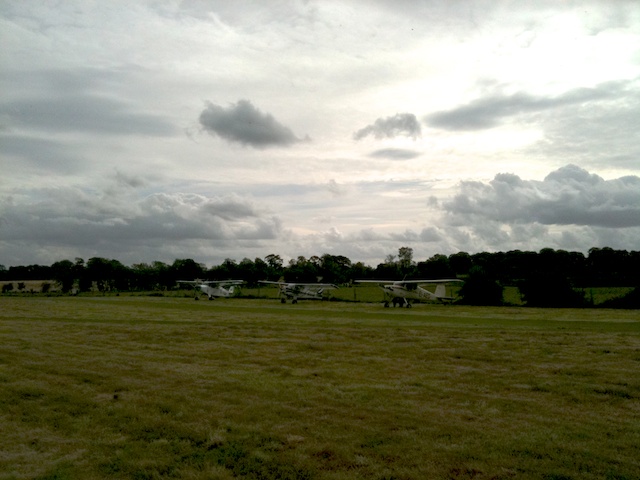
[caption id="attachment_148" align="aligncenter" width="640" caption="View at the apron, all the visiting aircraft"][/caption]

[caption id="attachment_147" align="aligncenter" width="640" caption="View at the apron, all the visiting aircraft cont"][/caption]

Nonetheless, I decided to ask someone if it is possible to have a ride with instructor. I was pointed at a very nice chap name William, as it turns out he is the CFI. We got there around 15:30, and he said it might be a while later before I could actually go and have a go. Well. It would be a wasted day otherwise.

We spent a bit of time with Kate, looking around the aircraft on the apron. She was quickly bored with all that, as since we knew no one, and I only had breakfast, we decided to have something to eat at the nearby town of Trim. Plus, the club doesn't take cards ,so cash and fly is the name of the game. I needed some paper.

Trim is a small town, with a very nice castle. And quite few places to eat. We went there to have something to eat, got some cash out (as it turned out, the diner was taking cash only too, what a place..), and went off to see the castle. The entrance was 3 euro, just to see a patch of 3 acres, so imo wasn't worth it. We just went around the castle to see the place. It is a very nice place indeed. Very quiet for Saturday, and all in all very nice.

[caption id="attachment_149" align="aligncenter" width="480" caption="myself in front of the Trim Castle "][/caption]

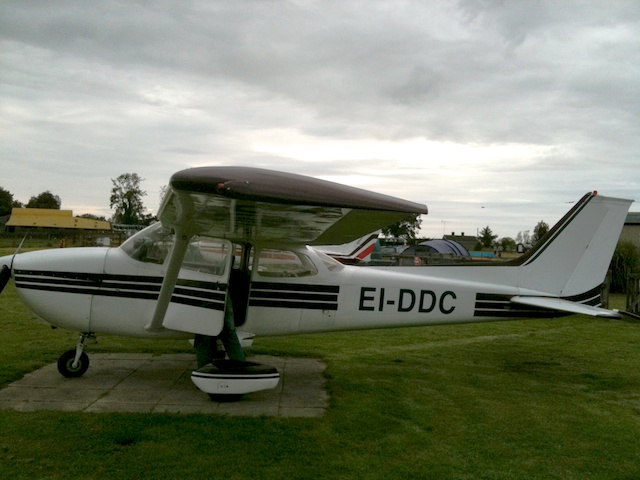
Went back to the aerodrome, I got ahold of William, and told him that I am still very keen on getting up. I guess the guy was either staggered, or couldn't believe that I am still willing to stick around. :) There was some chap having his PPL exams taken, and he was waiting for an instructor. There was an aircraft waiting and prepared for him, so William didn't wanted to use it. Meanwhile, the aircraft I wanted to go in, EI-DDC, has been away with another student. So had to wait for them to comeback.

At around 18:00, I saw the aircraft coming back, for touch and go. And than after a circuit, they landed for full stop.

Few minutes later William said, that it is the time :D I couldn't be happier. Altho, after them few hours of waiting, it probably didn't show. Mind you it was windy, and we were waiting outside all the time.

Went to the aircraft, for a preflight. As with every CFI , William was very through in his preflight checks. And I also learned few new things.

For instance, they use wooden spoons (serious) instead of dip sticks, to check fuel levels. This is because, they don't want them to drop into the tank. Very wise. But seemed to me very odd indeed. We then went on to take some fuel samples, and they were all great.

Went around the aircraft as well, and William pointed me at few things that I've never checked. For instance, he checked stall warner with his lips. Serious, you just have to put your mouth around it, and suck in a bit of air. Never seen anyone doing it to be honest. I shared couple things that I would do. Every single guy would do checks more or less differently (and I am talking about extra things outside of the checklist). So you learn every single time, you talk to some other pilot. I like it about that profession. People are not shy in sharing things. They know, every single thing you share, could save someone else's life one day.

[caption id="attachment_146" align="aligncenter" width="640" caption="The aircraft for the lesson"][/caption]

It was also understandable, that William - never seeing me before in his life - was going through things with me, as if I never flew an aircraft before. Quite strange feeling, as so far I've been flying with people who at least had access to my records. So could see that I've been doing things.

I jumped in, and very first thing I noticed, was that instruments were in different spots from what I normally would see in Ards on 172.

One of the first things on the checklist, even before you start an engine, is to extend flaps. And there's the first foobar that I encountered. Where the hell is the flaps thingie. Needless to say, there was nothing like it on the panel. I was slightly puzzled. It turned out, that on the older 172s you get 3 way switch, and a gauge. So you need to operate the flaps, and check the gauge to see where they are at.

Another new thing I learned, was to check the ailerons, first to the left, and count one-two, moving yoke to sides. And than same thing for right. They obviously need to move in different direction.

Started the engine, and there's another gotcha. Where the heck did all engine monitoring stuff go. It turned out to be on the other side, Again William had to point me to it.

We went off. Never ever before did I had a chance to taxi on a grass. So first word of advice was, sloooow. Much slower than would I would do in Ards. Another thing, he showed me, was to test some of the instruments whilst taxing. Just do few turns on the runway backtrack, to see how things are moving. Nice. I did a bit of mess when turning for the power checks. So my instructor took over again.

I lined up, started to push the power slowly in. As always, was told to do it quicker. Rotated, and it turned out again, that I pulled too much. As it turned out, the ASI is in mph not knots.

William than asked me to level off at 2000 ft, probably due to the dublin airport zone above us. Obviously, I did a mess of that. Pulled the power too early.

Than was a procession of failures. But that's my point in getting a go with someone else, somewhere else. Originally I wanted to do this back at home, but my cash buckets were running out.

He than proceed to ask me to get slightly higher up, make few turns. Than a bit of approach configuration training, trimming, etc. I did a bit of mess of everything, but was much better than last time I was doing all that to be honest.

We went a bit to the north, than turned west. All I could see were collection points on , what I thought was M1, but it was M3. It was time to head back. To be honest, nothing on the ground looked familiar. I of course, never been up in the air in the area before. And there's another thing, if you look down, and search for a farm strips, there's a surprise. There's farms wherever you look, with exception of some small towns.

I was guided as to how to set it for an approach. So far, my past quite few lessons were in 152, so I had to be told what to set to what. And as always, I was too low on the approach. (btw, I tend to do same errors in X-Plane, when I tried my skills on approach there).

William took over the landing, as again, we flew together for the first time, and of course he couldn't trust me that I would do it right.

I did a bit of taxing back to the apron in front of the club, but William parked the aircraft on a nice little concrete patch where it will be parked.

During the debrief, William explained to me why and what we did, which only agreed with my suspicions. That he was trying to see what can I do. He was very aware, that most things I did wrong were due to differences in the aircraft. One biggest criticism he had, was that I wasn't able to keep headings too well. It is something that have happened to me many times in 172s before. The more powerful engine, makes the yaw much more noticeable than in 152. In 152 I pretty much don't have to use much of the rudder to correct it, whilst 172 is very demanding in this regard. Of course, bank being secondary effect of the yaw, uncorrected, caused us to deviate of the course. And obviously, since I did a lot of power changes in the air, required rudder would be different depending on the power set at a particular moment.

I paid my fee, got back to my car. We headed back, but I needed a bit of rest on the way, I was so knackered. We stopped at a random petrol station, to fill it up. Since I had some euros left, I wanted to spend them. Plus I always like to fill it up, when it is under half full (or over half empty). Of course had to encounter some of my compatriots, showing off not so good attitude. No wonder locals than look down on me, because of my origins. Well...

On my way home, literally 2 streets away from the house, I got stopped by nice folks from PSNI. The PC that stopped me, told me that he can smell alcohol from me :D . Funny, cos I wasn't drinking since the beginning of July. I think he smelled my windscreen wash, as it was raining, and I just sprayed my windscreen massively before turning into that particular street. So 5 minutes later I was free to go home, and finally crash on my bed after a very exhausting day indeed. (it is a 2h drive each way, to/from dublin area from where I live).


  • Route: Departed to the north, for general handling, than went to the west, and back to the aerodrome.

  • Milestones: First flight outside of EGAD, and first one on a grass strip.

  • Exercises covered: General Handling

  • Weather: scattered low clouds, quite windy, and some rain.


Tuesday, 17 August 2010

Lesson 17, it's been a while.


Lesson: 17


16/VIII/2010

  • Lesson time: 0.7h

  • Total time: 13.5h

  • Location: EGAD

  • Aircraft: G-BNKR (C152)


It has been a while. Constrained by finances, after holidays I decided to get up in the air. Took Monday and Tuesday off, due to my birthday.

Haven't flown for 2 months as it turned out, and having these two days off. I phoned the club on Friday, to book Monday with Roger. He is a great instructor, very patient one. And it is a shame that I don't get a chance to fly with him more often. But unfortunately he is in the club only on Mondays and Fridays, which doesn't suit me a bit.

I got in earlier, was booked for 16:30, but got there around 15:30. I decided to end up being precisely on time, or even late sometimes. With embarrassment and bad name, comes many lost occasions to get up in the air earlier when you are just on time, or slightly late. So decided to rectify my name a bit in this regard.

The club felt slightly different, certainly more quiet - but that's because it is not weekend day. I re-read anything that I could forget (checklists, etc). Around 16:15 went over to check the aircraft.

Even the pre-flight felt strange. Like I said, it has been a while, and I have lost the groove. Had to remind myself what to do. Obviously, I know the theory, but after that time I wasn't doing it as smooth.

The bonker has new engine. And apparently went through extensive checkup. I gotta say, it was felt during the preflight. Ailerons were working smoothly as never before. Obviously engine inside looked silvery and shine. New cap and dip stick. New gears.

It wasn't as clean as I remember it from the last time tho, plenty of bugs stuck to it all over the place. yack.

Jumped inside, creamed up to my seat. It is funny also, how you forget where some instruments are. I noticed some new electronics inside as well. Nice.

Spend a bit there, with rain getting heavier. Obviously, aircrafts not having windscreen wipers, you can't see anything. The propeller is a wiper, in a way. Roger have joined me after a bit. We had only 1/4 of fuel in each tank, and he was concerned but decided that we can go and fly anyway. Very well!.

Taxying was unexpectedly easy(er). Even Roger noticed, that I no longer taxi in a serpent trail style. Did bit of a mess before the hold, I decided to turn with the wind to do my power checks, rather than into the wind, so I quickly just did 360 deg turn instead, did my power checks and off we went.

Of course, forgot to pull the yoke on the roll, so typical. And off I went, rotate at 60.

This time, having just studied the checklist, I decided to do all of them by the book. So ELF checks at 300 ft, (C)BUMPFISCH + radio call on downwind, call before turning finals, CRAP on 300 ft on finals. Radio work was never so easy to me. Of course, first approach configuration ended up to be a complete mess.

Roger previously was telling me, that approach configuration is his thing. He is very particular about it, and I know very well why. I do fully agree with him.

Part of being 'rusty', is that some things just don't come around first time. So when I was trying to fix the picture (attitude) by pushing control column, rather than using power on the approach, and doing opposite when I got 30 deg flaps on finals. I should have being using stick for it, and retrim it. Trimming wasn't so bad, but not as smooth as it used to be.

Overall, this was a lesson in reminding myself all these little things that I have forgotten. Or perhaps that's a wrong word. I do know all that. But when it comes to do it, I don't do it right.

After each circuit I got better and better, but than it was time to finish the fun. The weather wasn't getting any better.

The touch down before last, we had quite few dozen of seagulls all over the runway, and I got quite worried, but Roger said to press on. They all just few away as soon as we got close. Engine caught in an odd fashion, only once. We went off for the last circuit.

Last landing ended up in probably with 3 bumps. But Roger was very patient, and let me fix it.

We got back to the apron, I had a chance to taxi it back nearly to its hangar. Very odd to taxi so close to hangars.

All in all , lesson was very good. I certainly enjoyed it. It was a very good thing that I chose Roger to be the instructor for the day. He has this patience, that probably no one else in the club has. Even if I screw up, he will let me fix it, rather than take over straight away. It certainly makes for better progress.

Whilst waiting for Roger to comeback from his previous lesson, before preflight. I learned from Anthony that him, and few other instructors are leaving the club. For most of them, work in the club is just a way to get some experience and hours in the log book. That's a shame, because some of those instructors (including Anthony), I will miss. Hopefully new people will be as good as them.

I really enjoy this flying thing ... :D During my lunch break, I would walk around a park, over hills. And look at aircraft landing at Belfast Airport. I always think than, that this could be my job, if I choose to...


  • Route: RWY 22

  • Milestones: I'm back!

  • Exercises covered: 12&13

  • Weather: scattered clouds, quite windy, and rain. Slowly deteriorating weather.


Sunday, 20 June 2010

Lesson 16, Gregg demonstrates how to land .. not


Lesson: 16


20/VI/2010

  • Lesson time: 0.8h

  • Total time: 12.8h

  • Location: EGAD

  • Aircraft: G-BNKR (C152)

  • Instructor: Anthony S


Today was perfect day for flight. For some reason, there was not that many aircraft in the circuit when I drove close to the airport. Got bit worried by that, but they were flying alright.

Went out to checkout G-BNKR, it wasn't much flown Today for some reason, and my lesson was to be either last or one before last of the day.Odd. Plenty of fuel, everything in order otherwise.

Here's how it looked as I walked towards:


Now, here's a thingie that I noticed inside, the dark bit facing front. I wonder if this is so that you can put a camera there. If you know, let me know:


I did much better job taxing us to the 04 hold. Turned around nicely (Anthony asked me if I could do it) - well, in my own world that is.

And off we went. 6 circuits in whole. And everything was fine, more or less, except for the approach and landing...

I don't know what it is, but I approach more or less good. And than before the flare, madness starts. I tend to do opposite things to what needs done.

For instance, you are suppose to gently pull power and pull yoke, and let aircraft slowly and gently sink to the ground. Instead, when I see it dropping to fast, I add power, or push the stick. So out of 6 landings, probably one or two were not rubbish. Seriously. I do have to work on approach and landing some more, if I ever want to show anyone that it won't be a suicide mission to send me for a solo.

Anthony probably thinks, I am ignoring all he says. But truth of the matter is, I am trying to get a feel for all that stuff , so that I could do it myself, and react to things as they happen. Probably not the cheapest way to learn to fly (and land), but me thinks, most beneficial in terms of capabilities and knowledge. Let's just hope G-BNKR will survive that ;)

I won't bore you with details here, but out of 6 landings, we had to go around 2 times.

Side note, Kate bought me Red Ferrari ... perfumes yesterday. So Today I decided to put some on, prrrrobably too much. Anthony had to open window on one of the approaches to get some air (either that, or it was because I was running in sweat - it was damn hot). They are pretty intensive, so note to self, use less of it :)

Picture of zzz bonker's dashboard:


And circuits. One good thing, if I can think of one - is that I am taking off in much straighter line now. :)


That's it folks. Shortest post ever, I guess :)


  • Route: RWY 04

  • Milestones: Flap-less landing (twice). (70knts instead of 65)

  • Exercises covered: 12&13

  • Weather: scattered clouds, bit of wind, but otherwise perfect day for flying.


Sunday, 13 June 2010

Lesson 15, approach, flare, more circuits


Lesson: 15


13/VI/2010

  • Lesson time: 0.7h

  • Total time: 12.2h

  • Location: EGAD

  • Aircraft: G-BNKR (C152)

  • Instructor: David Phillips


The weather wasn't very stable Today. Phoned in, and was told to show up anyway. Metars were showing possible storm, but you never know.

So I got in, a bit early. Interrupted David in his lunch (sorry David). But he insisted on sitting down, and going through what we are going to do Today. So I did. This was quite a bit of preflight. With some math, etc. I like that :) . Anthony joined in as well, whilst he had his quick lunch.

Without getting too deep into details, David walked me through approach configuration, when to flare, and landing bit. And that was to be my focus for the day.

I than did preflights, and jumped into the aircraft. I got worried about weather, it started to be more gusty. You could see some rain clouds to north, and clear skies to the south.

David joined me in few minutes, and said that we should be okay, and if not, we will just go back and wait. So I went on with the usual business. I got a chance to pretty much do the whole taxing this time, with virtually no interventions from instructor (or maybe just got lucky, or better after a bit of practice Yesterday). As it turns out, for the RWY 04 you can't just backtrack it. It is rather long, and someone might fancy a landing while you are crawling back. So about half way through we went to the right, and tracked back just before start of the RWY.

On my initial climb out, I this time around was consciously trying to keep my heading alright. And it kind of worked. As usual wind was blowing me all over the place, but I tried to keep me on the same heading. David took over for a second, and let me see through rear of the aircraft. It looked not too bad. (to be honest, anything is better than what I did Yesterday anyway :P ).

The circuit was right hand. First time I ever flown one. Not much of a difference, except that there's some bloke obstructing your view when you try to pick reference point (for turn), and do look out ;) But he also tends to spot things for you, so it works out well ;)

Whilst first part of the circuit was clear, the second bit of downwind, and base were covered in rain. So it was hard to choose any reference points, and David said to make the circuit low. Don't remember heights (you can look it up on the gps track), but it was lower than usual 1000 ft.

As usual, my checks were rubbish, and I didn't managed to do any radio calls whilst in the air. Oddly enough, whilst flying with Roger, second circuit and later were spot on, and I did all the checks. Probably just the learners experience effect. As I progress, I see more and more things.

Since my focus was on landings and approach, David walked me through that, and pointed at whatever I was doing wrong.

In essence (so that I won't bore you with too many details) I did my approaches too low, and have a 'ground shy' tendency. That means, that I am afraid to lower nose, even tho I am flying too slow. That in turn causes (obviously), the glide path to be wrong. And if I start to pull the stick, to get away from ground (instinct tells you that you are going to crash if you put nose down, but in reality, you'll gain some speed, and your glide path will be more gentle) - things will only go wrong. I just have to practice that bit of landing more and more. On top of that, decision as to when to flare, and what to do in landing. But I guess, I got that better after this lesson.

So here's my first circuit:


Second one was just pretty much a repeat of the first one. With me trying to get my checks in better order:


For some reason, my GPS (iphone 3GS, and app's called MotionX GPS - very good app) lost signal few times, hence the straight line on downwind, and rather funny looking base.

After the two circuits, David said - 'look , your circuits are fine, it is the approach and landing you need to practice, so I'll make this one a quickie and leave you just to do the approach'. Idea was great. I get to do more, in less time. Always good :)

So basically he flew rather accelerated circuit, very tightly, and left me to do the final bits. Here's how it looked:


This was very quick one indeed. Upon doing that one, I discovered that it is probably the people, houses and stuff that makes me even more susceptible to the 'ground shy' effect. Basically, I can see all the movement on the ground, and I should be concentrating on the RWY and aim for the numbers.

Next one was full size, and I don't remember whether David was showing me the approach on this one, or I did another one myself. It looked like this:


For the very next one, David decided to go and fly RWY 34 (with the chance to fly over Scrabo , the bit that I like about it most :) ). There's no distractions on finals. You just fly over water. There is always someone on the sea wall, just passing underneath the aircraft as you try to land - but that doesn't make me worried too much. And I think this one was much better. Altho, I still feel like I am flaring too high.


Last one was to be a quick one, so again David did expedite us and set me up for approach:


He said this one was spot on, except for the approach, which was too low. I still seem to have to work on it. Well, that's the whole purpose of training, isn't :)

Once landed, he just said 'now take me home'. Wasn't sure if he was proposing another trip , or just wanted to go back to the clubhouse ;)

Overall, new instructor, new experiences, new perspective. This way it will probably take me longer to get the license, but I will also get more out of it (hopefully).

I know David will probably read it, so if I left anything interesting out, or got something wrong, let me know.

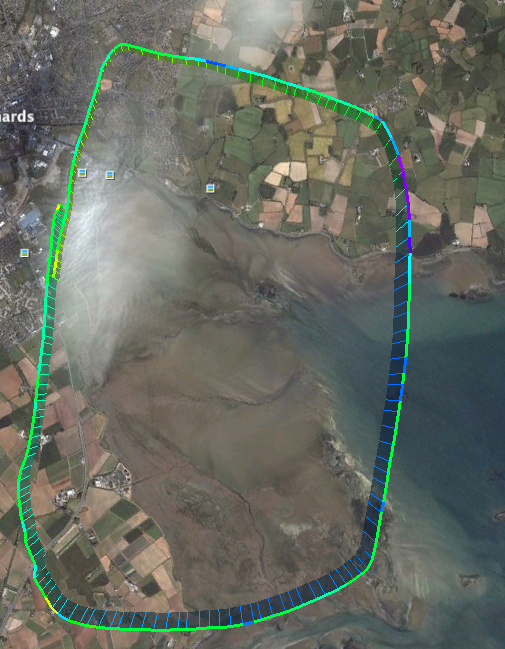
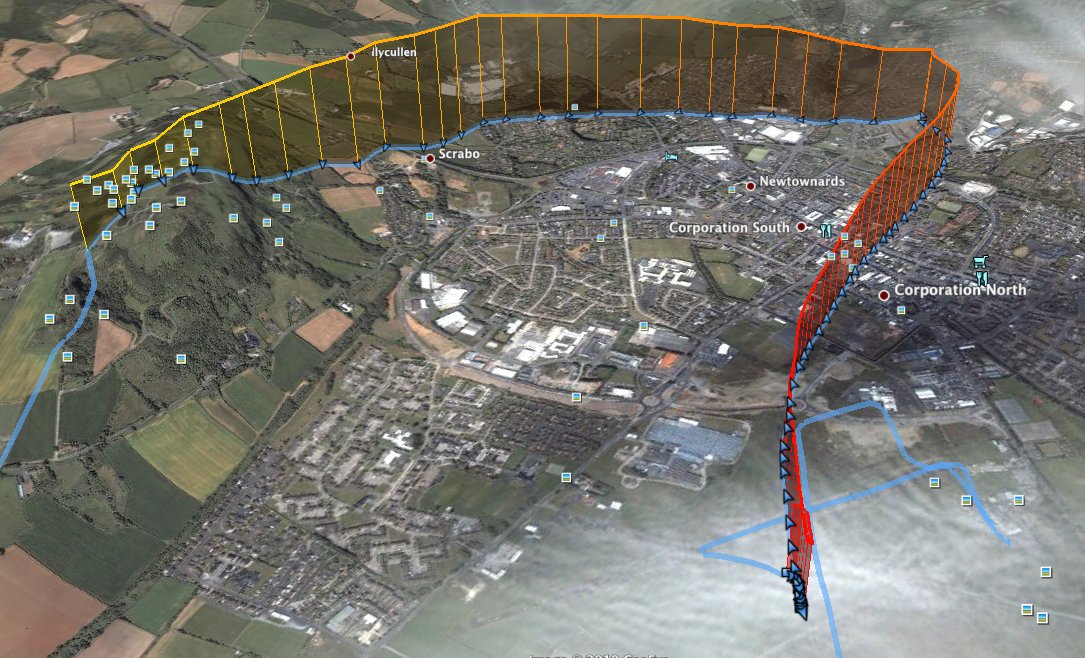
Finally, here's the full track (check out options->tour feature ;).

And btw, let me know,if you think I am putting in too many tracking images.

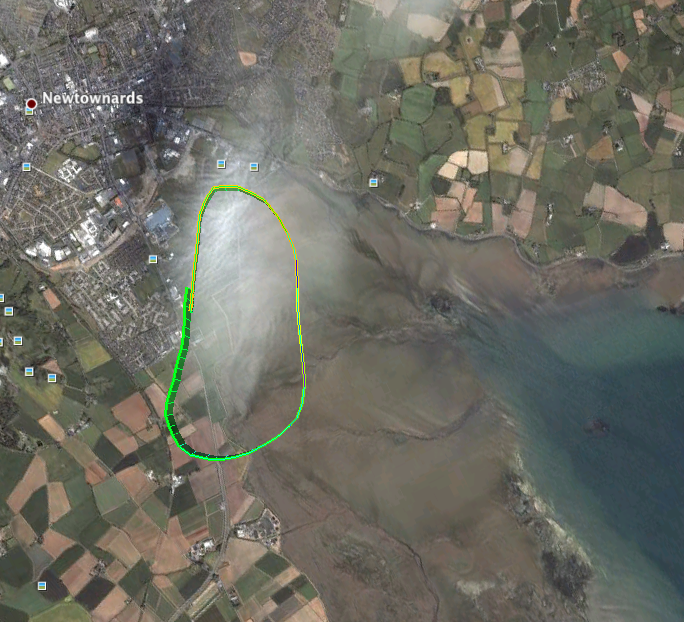
All screenshots above are from Google Earth.


  • Route: RWY 04 and 34

  • Milestones: hopefully got better understanding of approach, and flare, flew in rain

  • Exercises covered: 12&13

  • Weather: quite a windy day, some showers


Lesson 14, steep turns ... G-fun :D !


Lesson: 14


12/VI/2010

  • Lesson time: 0.8h

  • Total time: 11.5h

  • Location: EGAD

  • Aircraft: G-BNKR (C152)


I had a bit of break away from flying. My last flight was bit over month ago. So bit nervous, will I remember the drill ?

Got to the club just before 9, Anthony was already there. Got out of the 'instructors room'. I could see CFI was a bit puzzled as to which runway to choose, as wind was changing a lot.

I sat down, and Anthony told me that circuits are not going to be possible Today - I thought, great, so no flying. But no, turned out, we could do a bit of flying, but we have to go high up - air is much more "smooth" there. I am to do some steep turns. Well, always welcome new things.

Went out to do preflight, and soon Anthony joined me to ask me, if I wanted to fly C152 or C172. Apparently I was booked for C172. But C152 was free, and I do remember that I booked for C152 anyway (had it written down on my iphone when I booked). He went away, just to join me moments later.

Here's pic from apron cam, of me doing preflight:


You can even see some sun shining of my bald spot on top of my head :P

I was amazed how quickly I got back to reading the checklist, everything went very smooth.

As usual, taxing to the hold, and than across the runway was done in a serpent's style, but you wouldn't believe how uneasy it is to control an aircraft on the ground. After all, it wasn't designed to be driven, but was designed to fly.

Rolled to 26-34 hold ( see EGAD chart here in PDF ). Due to me being rather slow (other do the power check list very quickly from memory usually), we let guys past us, and than I did power checks. Much quicker than usual, because I already know what's coming next. And where's what.

Entered active, and backtracked it. It is funny how they always insist that I turn on the very last patch of asphalt. It is understandable, but with my still sloppy taxing skill, makes me slightly nervous.

I turned the aircraft around, and asked Anthony with grin on my face "you're ready for this?". It has been a while, so I could expect everything. Plus, I knew that the air is quite turbulent Today (gusts to 20kts I believe). I pushed the throttle, counting 1-2-3 whilst doing it. And off we went.

It doesn't bother me anymore as much as it used to, when wind tries to push you down, despite the fact that you are trying to climb up. But it is some interesting feeling. As usual, my climb out was crap. I still have to learn how to take off in straight line, rather than be blown away. Sometimes I think, it would be nice to have a rear view mirror on an aircraft (and horn, so you could scare off people wondering around the apron ). So here's my climb out, and first circuit bit profile. Cringe if you must. Advice is welcomed :P

(btw, here's the whole gps track )


As you can see, I got blown to the east quite a bit. For some reason it always happens. Perhaps because it is hard for me to follow reference point, whilst nose is up (since you see just a blue sky). My other suspicion is that I just turn to the right instinctively. Dunno. I guess it is just a matter of practice.

For the record Anthony tried to tell me about it, but he gave up I guess. We did quite an overpass, over scrabo tower. and than left circuit to south south east for some G-pressing steep turns :D

Usual trip is up to mount Steward, than switch radios over to Belfast approach, request basic service. Usually they say, not to go above certain height. This time, we climbed to 2600. I was doing quite well, oddly enough. Maybe apart from the fact that I started to level us out too quickly, and ended up loosing some height due to lack of airspeed (APT acronym, lookup my first lessons on that).

Anthony demonstrated the exercise. Basically, due to way wings work, lower wing is quite a dragger. Also, the lift component is really working under quite an angle. So for these reasons, you need to pull back, in order to stay on the same height, and add just a tad bit of power. I did it two times to the left. Anthony said he is really pleased with result. For the next one, he covered my 6 pack, thus forced me to look outside. To my amazement, this one was the best one so far. Even tho, I glanced at the instruments, I would mostly look at the attitude indicator. Just to make sure I am in 45 deg turn. Cos I have the tendency to go back to 30 or less. Basically, the idea is that you enter the turn, as you go past 30 deg, try to pull back so that you are on the same height and if you see that the nose tries to drop add just a bit of power to counteract. After that, pick a point on dashboard (or between screws on the cowling), and keep it there. Pretty simple.

Than we tried few right hand turns. These were trickier. When you do left turn, you are below horizon. On the right turn, you feel like you are on the top.

Anthony than demonstrated 60 deg turns, and also quite quick descending. Quite frankly, a this point my G-O-Meter told me I was nearing my physical limits plus we had to start to head back to the airport so I passed on offer to try it myself.

On my way back, Anthony wanted me to try to talk with belfast approach. But he passed on second thought. Also, asked me if I did any exams yet. I haven't. I don't even have medical yet. And I know time is pressing, and I should have at least airlaw and medical if I ever want to go solo around circuit. He also mentioned that there is going to be radio course pretty soon, and if I was interested. Of course I would! As for the airlaw, I would love to see course with airlaw as subject too. So far I've been scoring 60% on airquiz at most. Which is pretty poor result if you ask me.

Nearing the airport, I setup the approach configuration. Anthony helped a bit, and I did my best to land. But for some reason he took over about 300ft from the runway. I am still convinced that I was able to do it, but due to the winds probability of us going around was over 40%, and I guess he didn't wanted to chance it. Oh well, plenty more chances to do it ahead of me.

Once landed, I again was given a chance to get us back to the apron. On our way back, on RWY22 we passed C172 running on diesel (JET-A). Apparently, some photographers flying around. Diesel engines are making more and more market share in GA these days. Probably JET-A will no longer be so cheap once they get a major chunk. After all, some people live very well of our taxes, and there's tons of tax in fuel (even avgas)....

Got back to reception, to renew my UFC membership, and pay for the lesson. As it turned out, there's two "foreigners" training at the club, and they have our names sticked on top of the monitor - to make sure our names are spelled correctly. Embarrassing to be honest, slightly. I do promise, that if I ever get local citizenship I'll think about changing my name to Johnston or something simpler for everyone here to spell ;)

To summarise, it was nice to get up and fly. I did enjoy it. Never had such a grin on my face when paying 90 quid for 45 minutes in the air :) Serious fun.


  • Route: RWY 34

  • Milestones: pressing some Gs, 45 and 60 turns :D

  • Exercises covered: 15

  • Weather: clear skies, very windy tho - especially below 1500 ft.

Friday, 23 April 2010

Lesson 13, importance of landing configuration

Lesson: 13


23/IV/2010

  • Lesson time: 0.8h

  • Total time: 10.7h

  • Location: EGAD

  • Aircraft: G-BNKR (C152)

Another change in instructors. I was booked with David H Today, but someone amended it and I was to fly with Roger. Well, no complaints here. Roger's virtually perfect instructor. And I am not sure about the need to use the word virtually here either. :)

I got in, a bit late, Roger was sitting rather relaxed in front of a laptop. Weather wasn't perfect, so I kind of thought that we won't fly, but he said that everything is absolutely fine.

Great! He wanted me to jump ahead and do external checks, but I had to ask him for a brief. Because I know they all have their own styles of flying and teaching, I knew I could gain something from his. He has always been a great source of knowledge in the field for me, and I was not to be disappointed this time either :)

I sat down in our little room, and he went on to describe how he thinks things should be done. Now, his description wasn't any different from Anthony's, up until the point where we turn on base, and we gotta start configuring aircraft for landing.

He was very detailed there, and couldn't really make it any clearer that this is his thing. He always underlines importance of this. Now, probably because I already flew few circuits , and most of them were rubbish, and landings especially. And because Anthony explained whole thing to me already, I mean everything - pretty much on the same level. And because I know I am rubbish when it comes to approaches ! I was very interested in knowing how to do it precisely.

And I mean, Roger was very very serious when he said - that this is the most important thing when flying circuits. So here is what I do remember (probably not everything in such a detail, and I hope Roger is not reading this :P) , this is for C152 and your millage might vary:

  1. pull power to about 1700

  2. as soon as you pull the power, aircraft will try to maintain the speed, and nose will drop (if trimmed that is, but I assume I am trimmed most of the time

  3. that means, pull the nose, not to loose any height (and he marked it with 2 exclamations here)

  4. as soon as speed is on the white arch, first stage of flaps - maintain the height (3 exclamations)

  5. second stage (20 deg), maintain that height (3 exclamations again)

  6. setup for 65 knots (C152), and trim (3 exclamations)

  7. turn finals (you shouldn't be below 600 ft at that stage, ideally)

  8. 3rd stage of flaps, aircraft if trimmed should pretty much fly itself 60 knots at that stage

  9. do the CRAP checklist (Roger didn't mention all points here, but that's the power of having more than one instructor - you get to learn more :D )

  10. use power to maintain the approach , if trimmed well - around 300 ft above ground you shouldn't really need to use any back pressure at all unless obviously you are in a bit of wind

  11. 30 ft above ground, flare. pull the power gently, pull the yoke towards yourself, and look ahead - at the end of the runway

  12. if it wants to drop pull, hard at first, and than gently so you don't balloon

  13. providing that you did all great, the aircraft should kiss the ground itself, basically sink as the speed bleeds off.

  14. you haven't landed really until you're in full stop, or 'go' configuration - ready for another one.

I also asked about taking off, and setting for cross wind effectively, and what about the bounce on flare. The first one - is just a matter of practice. The bounce - Roger was very very clear here - that if you bounce off the runway - always go around. Don't fuss around.

And that's about it. Sounds simple. And to be honest, with 10 exclamations from myself, setting up is the shit maaan! I mean really, focusing on that was what I was missing on previous lessons. To be fair, Anthony introduced me to the whole concept. And now I'll just have to practice any bits of it that will not be as good as expected.

So, that was a brief, it took about 40 minutes, but again - Friday, everything was so relaxed, no traffic in circuit. Peace on earth ... :D

I did my preflight, setup some iPhone app to track my flight - but it turned out to be rubbish, it only recorded 10 minutes, and stopped. I'll find better one next time.

I went to my car to grab some water, as I was thirsty as hell (just had a chicken - loads of proteins make you want to drink a lot). Meanwhile Roger was adjusting the 'square', to reflect runway in use change (to 16).

I got back, did all check from the lists. And pretty nicely taxied us to 16/34 hold, where I did my power checks. Meanwhile Ian was just coming back from cross country, and passed me by whilst I was doing my checks. Nice backtrack on 16, snake trail of course ;) but I am getting better at it. Basic hint from Roger was - add bit more power, and the prop wash will make rudder more effective. It works that way. He obviously made it very very clear, to only turn around at the very end of the rwy. Pretty much kissing the grass.

I turned around, and because of the sea wall at the end of it, I knew that this is just very short. When you line up on 22, you have miles ahead of you. Here. you can tell, that every feet of that runway matters. Hence why turning so tight at the end of the runway was very important.

Very quick 1-2-3, power in, 55 kts, rotate, Vy (best rate of climb) - 65knts, and off we went for the first one.

I asked Roger to prompt me along the way. He virtually did nothing, but just sat there, obviously helped with controls, but would tell me what to do next when I hesitated. In essence, I did checks, radio calls, and flying more or less myself. That really felt nice :)

First circuit was obviously just a warm up, and wasn't that good. But wasn't that bad either. Roger was covering up speedo (ASI), to see whether I could feel the 65 knots instead of looking at it. And to my surprise, after trimming - I pretty much made it fly at 68 knots. I was seriously shocked.

Again, prompted very much along the way, we managed to do touch and go. Again, I did the radio, and flying. It is really doable, as long as things are done promptly, and Roger was helping me out here, by reminding me rather quick what's next. It is also funny how everything really slows down once you are flying the approach speeds. All of the sudden you have a lot of time.

That was the first one, second time around, I pretty much did everything up to down-wind leg without any prompting from Roger. Again, really pleased with myself. Configured for the approach, and fscked up flare... Seriously, I tried to be gentle with controls, and failed to pull it promptly. It sinked, bounced off ... Aaaargh.

I had so much in my trousers, the runway is short, we already wasted a bit by bouncing off. But Roger set us up for go-around. He was describing what was happening as we went along. But it was scary. Pretty much, you jam in the power, loose carb heat, and get it to fly above runway. When that happens, raise flaps to 20 deg, make sure you have speed, a bit of positive climb rate (very important), and only than another stage of flaps up, etc. it is very important to not loose it, and fly steady just above runway initially, otherwise bad shit may happen.

I didn't intended it to be that way, but that way I was shown how to rescue myself in case I'll get that bounce. Also, another mental note, if anyone ever will be brave enough to fly with me - tell them to sit far away from control column. Not that they will start playing with it, but if I ever will have need to pull it, I need enough space.

Anyway, went on for another two rounds, pretty uneventful - smooth and relaxed. On my final finals, with full stop, I could see some guy lining up on the grass runway (parallel to 16). He probably only noticed me, when I made the finals radio call. I remember asking Roger about what should I do, there's an aircraft there. He just said, 'let him know where you are'. It was just nice, to notice radio calls in the works. I know it seems trivial, and you probably think I am mad for mentioning it here, but that really felt good, just to hear the other guy telling you that he will wait for you to land first. Even tho it was obvious.

This is one of the things with Roger, he always tells you if you improved, and patiently prompts you what to do if you failed. But you don't feel any anger there. Just patience, buckets of it. That really helps. After all, you need to be relaxed when flying. And also that makes you learn quicker. I noticed I make a lot of progress with him. Probably would resolve to only fly with Roger, if it wasn't for the fact that I do like to get input from different angles, and even if it costs more money (and time), I hope that pays off in the future. After all, if you want to save money, you really shouldn't be learning to fly in the first place. Seriously.

And that was my Friday pretty much. Thought went through my head, to ask him if I could come back later on Today and do some more :) If it wasn't for the fact that I have work, and they really don't like it when I take too much half-days off, I would only fly during week. It is much more relaxed, and enjoyable.

  • Route: RWY 16, round and round

  • Milestones: landing configuration recognised

  • Exercises covered: 12/13

  • Weather: bit misty, strange gust blows in certain areas (thermals?) over the city of ards

Sunday, 18 April 2010

Lesson 12, how (not to) fly circuits

Lesson: 12


17/IV/2010

  • Lesson time: 0.7h (confirmed)

  • Total time: 9.9h

  • Location: EGAD

  • Aircraft: G-BNKR (C152)

Decided to drop in earlier Today. Never again. I was told, that Anthony has someone before me, so I'll probably have to wait one hour before my time.

And so I waited.

Anyway, just as I got there, CFI landed in C152, after annual check. So it is flying, and probably I'll be able to fly in it. He was leaving it with two rather large suitcases, which made me think, that there's probably all Bonker's documentation. He was passing by me in lobby, but I wasn't sure if he would react well to that joke.

One hour has passed, Anthony got back from flight with 3 very happy ladies in PA28. And it was his time, to join the fatso I am and do some circuits in C152. Life's tough ;)

I got over to check the G-BNKR, and first thing I noticed was how clean it is. Someone probably spend a bit of time cleaning it, cos I couldn't recognise some marks that I got used to. Oh well. Even sitting inside, I kind of felt like I've never sat in this aircraft before, it was so different.

I went through my checklist, and everything was in order. Sometime has passed, and Anthony joined me inside too.

Going through the engine startup checklist, I noticed how smooth the engine was going. It started first time, and it was all-so-smooth. As I was about to taxi, CFI came over, and asked Anthony to shut down, because he thinks pressure in nose wheel is slightly too high. UFC's CFI is a really great man. He always thinks about everything around him, and not in a very bad way. There's not so many people like him. And every time, I have a chance to talk to him, or see him doing something - it always inspires me greatly. I wish I was a man like that sometimes.

Anyways, Anthony did a rather fast start-up (he remembers that checklist by heart). And off we went towards RWY 22 hold (exit point from UFCs apron).

This time around, he let me do most radio work on the ground, which was nice. I shared my fear of radio with him, and he said that it is quite normal. It was nice to hear, that he went through same thing, and even got few radio-gobble moments in his life. The button on yoke is seriously mind bogger, and lip tightener.

I did some more taxi work Today as well, which was nice, but I still am rubbish at it. Got us towards 34 in one piece, but Anthony took over last part of backtracking, and turning as there was somebody on finals, and he wanted to expedite our departure.

"your controls". I pressed the accelerator leaver in counting 1-2-3 in my head, not to do it too fast, but also to do it rather fast. "Faster, this is short runway".

As soon as I rotated, I could feel the bloody cross wind. Balance ball went all the way to the left, and I intuitively crossed controls. Very bad. Anthony took over, and told me to look behind. We were about 25-30 degrees off to left from runway line. This is very bad. I heard opinions about that runway, but now I can see how difficult it can be, especially when the wind is changing as it was on that day.

My first circuit was just rubbish . I turned as in wrong direction couple of times. Than again, the speeds were different. Again, another change from C172, in C152 - speed on climb out is just 65 knts. And that's it, no complications.

Made the first base/finals too tight, so far too high, Anthony asked me to pull the power, to pretty much idle, drop the nose, to regain speed. I could see people on the sea-wall stopping, afraid to cross the approach path. Very wise, cos I might as well come in too low..

That touch and go was seriously bad, but those that will follow were not much better.

On that initial climb I probably lost 1 litre of  sweat. Seriously. Probably after C172, I have tendency to pull to much, and we nearly stall.

The next one was much better, Anthony went on to demonstrate how little we actually have to turn to crosswind, due to ... crosswind. Since we were at 30-40 deg angle already, not much was require to turn. Same for downwind leg. I started to get interest in doing some checks myself, but I think that was a mistake. Anthony corrected me even, and said to just fly, and he'll do the rest.

Again, I turned base too early, and we were way too high on finals. Anthony demonstrated crossing controls, to loose height pretty fast.

I have to say, this is the phase that I shit myself on mostly. Finals, and the approach. You basically aim for numbers on the runway. Literally. So that if you don't flare, you would mash yourself over these numbers. So when I hear Anthony asking me to pull the power, I just think he is nuts, and do it very slowly. But he usually means all the way to idle!. Nuts! But I know he must be right, after all, he wants to live too.

This one we did as go around. And I got reprimanded again - for pulling flaps too quick. Anthony is very particular, unlike others - about pulling flaps in stages, and waiting for positive rate of climb before doing next stage. It maybe is possible, but in my case we would crash into nearby hill before I went through all 3 stages of flaps, and waited for positive rate of climb between each. But I will aim to do it that way!.

Anyways, this circuit was much better, except for that wind has changed (again), and RWY22 became active. So we had to extend our circuit, basically our base became downwind (see picture from previous lesson). This time RWY22 for full stop.

A shame, lesson was rather short, but Anthony saw that I was literally struggling, and was utterly rubbish.

Last time we spoke, he actually suggested to me, that I should start doing lessons in pairs. One hour in morning, and one in afternoon. And never combined (there's some other Pole training here, that does it, and I was told that it is really not to his favour, well, stubborn nature I suppose).

Well, maybe next month, if I even have enough cash to actually fly.

Anthony gave me good debrief, describing what I did wrong, and how he had to actually save the day few times, by helping me with controls. I am not very happy with my progress, but maybe it is just that the things I am doing are very hard. Dunno.

I asked him also, what he thinks about getting computer yoke+rudder pedals, and practicing on X-Plane. He just said, that it is very good for practicing procedures, but in my case it is much better to spend the money on 2h of actual flight in the real machine. I have to say it makes sense.

  • Route: initially RWY 34, last one rwy 22

  • Milestones: circuits...

  • Exercises covered: 12/13

  • Weather: little clouds, huge crosswind, changing directions , runways altered between 34 and 22 every half an hour or so.